
A Journey in Wing Chun and Life
For about 12 years, I trained in Wing Chun Kung Fu with real intent and focus. While I’m not currently part of a club, I still train and carry its lessons with me every day.
For those unfamiliar, Wing Chun is a form of Chinese martial art known for its focus on close-range combat, efficiency, and practicality—a system where skill and psychology matter more than brute force.
When I first started, I struggled. The movements felt alien, the concepts elusive. I’m never going to be the “best” martial artist or fighter, but thanks to the patience of my Sifu—teacher (Steve Jones, South Wales Wing Chun)—my Sigung—teacher’s teacher (Shaun Rawcliffe, Midlands Wing Chun)—and the support of my Sihing (elder students) and Sidai (junior students), things slowly began to click.
Wing Chun taught me more than just fighting techniques. It became a mirror, showing me my strengths and weaknesses, my limits, and my potential. It’s been, and still is, an incredible journey—one that has shaped not just how I move, but how I think and approach life.
This story, however, is about a specific chapter of that journey: my first, solo trip to Hong Kong.
A Crossroads
At the time, my life was in pieces. I’d just come out of a long-term relationship. We weren’t married, but we were engaged and shared a mortgage. It was the kind of relationship that burns bright and ends in smoke, leaving wreckage on both sides. After the breakup, we sold the house.
But the hardest part? Giving up my dog.
We’d adopted him from the Dogs Trust—a loving, intelligent companion who quickly became my shadow. Returning him to the rescue home was devastating. His eyes, filled with trust and confusion, still haunt me.
Losing the relationship, the house, and my dog left me hollow. I needed a reset—something drastic to clear my head and rebuild.
So, I booked a three-week solo trip to Sydney, Australia. (Though my time in Sydney holds its own set of stories, this one is about what followed: my journey to Hong Kong.)
The Unexpected “Yes”
Throughout this tumultuous time, I never stopped training. Wing Chun was my anchor.
One day, after an intense seminar and assessment led by my Sigung, I worked up the courage to ask him a question I’d been mulling over.
“Could I train in Hong Kong?”
I expected him to say no. After all, I was still relatively new to the art. But to my surprise, he smiled and said, “Yes, of course. Call this guy when you get there and tell him you train under me.”
He scrolled through his phone, showed me a number, and waited as I eagerly jotted it down.
“His name is Ting Kwok Leung,” he added with a grin, “but you can call him Patrick.”
Meeting Patrick
Weeks later, on the final day of my Sydney trip, I called Patrick.
“Hello?”
His voice was warm and welcoming. When I mentioned Shaun Rawcliffe, his enthusiasm doubled. He asked when I’d be in Hong Kong, where I was staying, and whether I’d like to meet.
We agreed to meet on the day I arrived.
Hong Kong greeted me with its dense, humid air and chaotic energy. As I stepped out of the airport, and after a taxi ride, into the bustling streets of Kowloon, I felt both disoriented and alive.
Patrick met me shortly after I checked in, and from that moment, he became my guide, mentor, and friend.
Training in the Heart of Wing Chun
Patrick dedicated himself to my training with extraordinary generosity. Despite a full-time job and family responsibilities, he spent hours with me daily—training in the mornings and evenings, showing me around the city, and sharing meals and conversation.
We trained in group sessions at places like the Ving Tsun Athletic Association or halls in Mong Kok and Sha Tin. Other times, it was just the two of us, practicing in parks, open spaces, or even outside Hong Kong City University.
In Hong Kong, public training is normal. No one bats an eye at two people practicing martial arts in the street. It’s a stark contrast to the bravado and curiosity such scenes might provoke elsewhere.
The quality of martial artists there was exceptional. Each practitioner brought something unique, making the art their own. It wasn’t just about physical skill—it was a study of psychology, personality, and perspective.
One unforgettable moment came when I trained and took some brief mentorship with Ip Chun, the son of the legendary Ip Man (Yip Man). Afterward, we even shared coffee and cake.
But it was Patrick’s mentorship that defined my trip.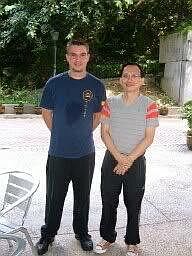
The Final Lesson
On my last day, Patrick and I trained together for the final time. Afterward, we sat outside a café, sipping tea.
“Tell me,” he asked, “do you think my teaching was good?”
I was floored. Here was someone who had devoted hours of his time to train me, guide me, and share his insights, humbly asking for feedback.
His question wasn’t just about martial arts. It was about growth, humility, and the never-ending process of learning.
That moment planted a seed in me—a principle I’ve carried ever since. Teaching isn’t just about passing down knowledge. It’s about listening, connecting, and being open to learning yourself.
A Tribute
Looking back, I see how much I owe to my Sifu, my Sigung, Patrick, and my entire Kung Fu family.
They didn’t just teach me how to fight—they taught me how to live.
This is a thank you to all of them.
Wing Chun isn’t just a martial art. It’s a philosophy of connection, humility, and mutual growth. It’s a reminder that no matter how skilled we become, we are always students, always learning—from teachers, peers, and even from those who follow in our footsteps.
So to my Kung Fu family, near and far, thank you for everything.

 Mathew James Ford